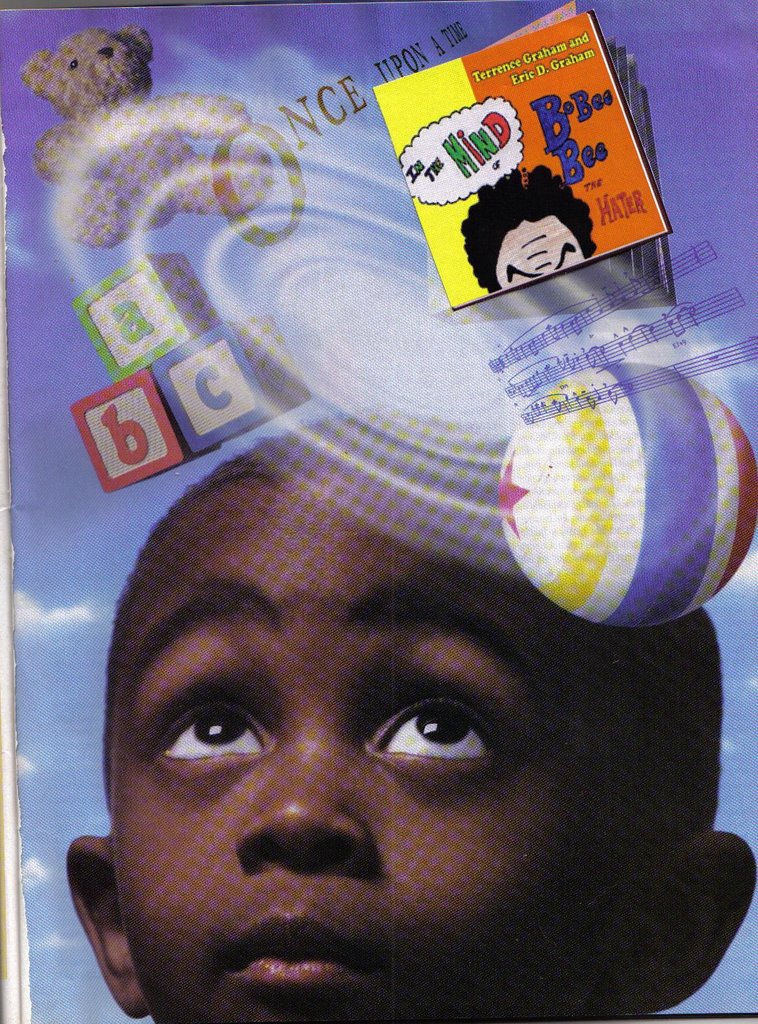
"BORN TO BE LOVED; LOVE TO BE HATED!"
His Anger Teaches Everybody Reality!!
It's your boy BOBBEE BEE "THE HATER" aka the trouble maker from the "city of brotherly love" I am an obnoxious, opinionated, third grader whose ego is bigger than T.O.! I am an "odd"combination of Terrell Owens, KOBE Bryant, Rasheed Wallace, and Allen Iverson!
by Eric D. Graham #TheRapProfessor. If you like what you are learning ($JeffreyBarnes)
If you find it difficult to come to terms with your sibling's or parent's mental illness, there are many others who share your difficulty.
Most siblings and adult children of people with psychiatric disorders find that mental illness in a brother, sister, or parent is a tragic event that changes everyone's life in many basic ways.
Strange, unpredictable behavior in a loved one can be devastating, and your anxiety can be high as you struggle with each episode of illness and worry about the future. It seems impossible at first, but most siblings and adult children find that over time they do gain the knowledge and skills to cope with mental illness effectively. They do have strengths they never knew they had, and they can meet situations they never even anticipated.
A good start in learning to cope is to find out as much as possible about mental illness, both by reading and talking with other families.
NAMI has books, pamphlets, fact sheets, and tapes available about different illnesses, treatments, and issues you may have to deal with, and you can join one of the 1,200 NAMI affiliate groups throughout the nation.
(For other resources and contact information about your state and local NAMI affiliates, call the NAMI HelpLine at 1-800/950-6264)
The following are some things to remember that should help you as you learn to live with mental illness in your family.
You cannot cure a mental disorder for a parent or sibling
No one is to blame for the illness
Mental disorders affect more than the person who is ill.
Despite your best efforts, your loved one's symptoms may get worse, or they may improve.
If you feel extreme resentment, you are giving too much.
It is as hard for the parent or sibling to accept the disorder as it is for other family members
Acceptance of the disorder by all concerned may be helpful, but it is not necessary.
A delusion has little or nothing to do with reality, so it needs no discussion.
Separate the person from the disorder.
It is not OK for you to be neglected. You have emotional needs and wants, too.
The illness of a family member is nothing to be ashamed of. The reality is that you will likely encounter stigma from an apprehensive public.
You may have to revise your expectations of the ill person.
You may have to renegotiate your emotional relationship with the ill person.
Acknowledge the remarkable courage your sibling or parents may show when dealing with a mental disorder.
Generally, those closest in sibling order and gender become emotionally enmeshed while those further out become estranged.
Grief issues for siblings are about what you had and lost. For adult children, they are about what you never had.
After denial, sadness, and anger comes acceptance. The addition of understanding yields compassion.
It is absurd to believe you may correct a biological illness such as diabetes, schizophrenia, or bipolar disorder with talk, although addressing social complications may be helpful.
Symptoms may change over time while the underlying disorder remains.
You should request the diagnosis and its explanation from professionals.
Mental health professionals have varied degrees of competence.
You have a right to ensure your professional safety.
Strange behavior is a symptom of the disorder. Don't take it personally.
Don't be afraid to ask your sibling or parent if he or she is thinking about hurting him or herself. Suicide is real.
Don't shoulder the whole responsibility for your mentally disordered relative yourself.
You are not a paid professional caseworker. Your role is to be a sibling or child, not a parent or caseworker.
The needs of the ill person do not necessarily always come first.
It is important to have boundaries and to set clear limits.
Just because a person has limited capabilities doesn't mean that you expect nothing of him or her.
It is natural to experience many and confusing emotions such as grief, guilt, fear, anger, sadness, hurt, confusion and more. You, not the ill person, are responsible for your own feelings.
Inability to talk about your feelings may leave you stuck or "frozen."
You are not alone. Sharing your thoughts and feelings in a support group has been helpful and enlightening for many.
Eventually you may see the silver lining in the storm clouds: your own increased awareness, sensitivity, receptivity, compassion, and maturity. You may become less judgmental and self-centered, a better person.
Permission is granted for this fact sheet to be reproduced in its entirety, but it must include the NAMI name and contact.
With his latest release My Personality is Borderline, people are starting to believe all the hype surrounding this mystery MC, who seemed to have come out of nowhere with his highly anticipated album Pocket Full of Ghetto Poems.
The so-called Carolina Rap Cat, from Magnolia, claims to have his mojo back and plans to deliver more mind-altering songs that push his listeners to the edge, with more thought provoking themes and videos.
Matter of fact, after hanging-out with some of his friends in Georgia at D'Cuban, a Cuban restaurant, which specializes in Caribbean cuisine, the self-proclaimed Black Poetry writer, who is known by some as "Steel Magnolia," felt inspired to pen a song entitled Guerrilla Prince, which is somewhat about the controversial Cuba Revolutionary leader Fidel Castro.
"This song Guerrilla Prince continues my revolutionary theme for the album/mixtape..."said the Radio and Television/Mass Communication major from Winston-Salem State University.
"Plus, it allows me to challenge myself creatively to try to rhyme over different percussions and instruments as well as educate the masses about the African-Cuban connection.
With Graham trying to broaden his scope and take his music international,while exploring different subject matters, he has a big recording session coming up in November in order to finish the project with his friend Supreme DJ NYBorn at Payroll Studios in High Point.
"I will probably release a few more songs by way of SoundCloud on Facebook before I buckle down on preparing to release the mixtape for purchase, which probably will be released at the beginning of the New Year." said Graham, who stays busy drawing his controversial cartoon Bobbee Bee "The Hater" for Black Athlete Sports Network, which he hopes to re-instate with all new espiodes next week.
"Man, I got some really good songs....But, I am still doing some test run on Facebook, in order to see what the people are feeling."
Up next, according to the Rap Professor, are song titles which include: Illuminati, I Got My Mojo Back, Too Cool For School, Black Women Sing The Blues, I am a True Master and One Day We Will All Be Free.
However, all this is subject to change like the whether.
But, I Can't wait!!
It's going to be a Hot Winter and a Cold Summer!!!
Plus, I gotta Pocket Full of Ghetto Poems in my back pocket.
Grief is a somewhat complicated and misunderstood emotion. Yet, grief is something that, unfortunately, we must all experience at some time or other. We will all inevitably experience loss. Whether it is a loss through death, divorce or some other loss, the stages of grieving are the same.
There are five stages of grief. If we get stuck in one stage or the other, the process of grieving is not complete, and cannot be complete. Thus there will be no healing. A person MUST go through the five stages to be well again, to heal. Not everyone goes through the stages at the same time. It is different for each person. You cannot force a person through the stages, they have to go at their own pace, and you may go one step forward then take two steps backward, but this is all part of the process, and individual to each person. But, as stressed, ALL five stages must be completed for healing to occur.
THE 5 STAGES OF GRIEF AND DEATH:
1-Denial-"this can't be happening to me", looking for the former spouse in familia places, or if it is death, setting the table for the person or acting as if they are still in living there. No crying. Not accepting or even acknowledging the loss.
2-Anger-"why me?", feelings of wanting to fight back or get even with spouse of divorce, for death, anger at the deceased, blaming them for leaving.
3-Bargaining-bargaining often takes place before the loss. Attempting to make deals with the spouse who is leaving, or attempting to make deals with God to stop or change the loss. Begging, wishing, praying for them to come back. 4-Depression-overwhelming feelings of hopelessness, frustration, bitterness, self pity, mourning loss of person as well as the hopes, dreams and plans for the future. Feeling lack of control, feeling numb. Perhaps feeling suicidal.
5-Acceptance-there is a difference between resignation and acceptance. You have to accept the loss, not just try to bear it quietly. Realization that it takes two to make or break a marriage. Realization that the person is gone (in death) that it is not their fault, they didn't leave you on purpose. (even in cases of suicide, often the deceased person, was not in their right frame of mind) Finding the good that can come out of the pain of loss, finding comfort and healing. Our goals turn toward personal growth. Stay with fond memories of person.
Get help. You will survive. You will heal, even if you cannot believe that now, just know that it is true. To feel pain after loss is normal. It proves that we are alive, human. But we can't stop living. We have to become stronger, while not shutting off our feelings for the hope of one day being healed and finding love and/or happiness again. Helping others through something we have experienced is a wonderful way to fascilitate our healing and bring good out of something
> If you like what you are learning, please leave a comment at lbiass34@yahoo.com and read our new children's book entitled "A SAD DAY FOR JOSE"
From Baby Doe to gerontology, medical decision making the area of the withholding, refusing or withdrawing life support has become increasingly difficult.
New technology has had the most obvious impact as patients, families and physicians are offered more and ever new diagnostic and life-prolonging equipment.
CAT scanners are being supplanted by Magnetic Resonance Imagery using no radiation. Lasers are treating everything from eyes to arteries.
Twenty week fetuses that were considered untreatable are now kept alive with new respiratory equipment.
But even though technology has increased our treatment options for trauma and long-term illnesses, it is usually not the determining factor in making decisions. Rather, there exist a set of subtle, extremely powerful myths about death which inform and direct our choices regarding life support. These myths are indicative of the collective beliefs about life and death in U.S. culture.
They are frequently used as impediments to decision making. Whether based on medical tradition, social obligation or religious teaching, the death myths influencing our decisions are indelibly embedded within the collective psyche.
They flash through our minds when the doctor tells us the patient’s condition is poor. They are the screens through which we hear the diagnosis of serious illness. They are standards against which we weigh our response to a terminal prognosis. The death myths most prominent in our culture are:
Only old people die.
Conversely stated, “Young people should not die.” Neither assumption is true. Anyone who has experience in hospitals knows that death is no respecter of age, and there is no guarantee of lifespan given with conception.
Further, it is ageism at its worst to think an old person has “lived his/her life” and is more accepting or more deserving of death than a younger counterpart. In fact, it is entirely possible for the situation to be quite the reverse; the aged person may be more vital and have more to live for than the youth.
This myth can result in young person’s being subjected to extraordinary efforts from intubation to chemotherapy just because they are young or old persons prematurely being denied further treatment because they are old. The myth also serves to reinforce our own wish for a long life, and to defend against our fear of our own death coming “prematurely.” Whether we like it or not, people of all ages die.
Each death is sad, tragic, and acceptable or a relief based on the quality of the person’s life and the kinds of relationships s/he had. Each situation, therefore, needs to be evaluated on those criteria, not on myth that presumes it is “okay” for old persons to die, perhaps intimidating that the elderly want to die or even ought to die.
2. Medicine can cure everything.
Even in the face of long-term illness when the patient is finally about to die, panicked family members frequently ask, “Can’t you do something?” This reflects a strong expectation that medicine can find and cure all illness and physicians are or should be omniscient. Most physicians do not act to reinforce this image.
The myth persists because we want to believe that drugs, medical technology, and their physician purveyors can prevent or cure the effects of disease, aging and self-inflicted injury (smoking, diet, lifestyle). In addition, the medical community has frequently oversold the efficacy or advisability of a particular technical or therapeutic “breakthrough.”
Thus, particularly Western culture have acquired unrealistically high expectations of what technology can do. The current promotion of the artificial heart is the latest example of such a media event. Heedless of the availability, advisability and ruinous financial cost of such a devise, the heart is proffered as another example of medical technology’s ability to cheat death-and so this myth is reinforced. It is more honest to be realistic with patients and ourselves about the limits of tests, treatments, medications, and prognoses.
3. Life is always the highest value.
The initial presumption in nearly any accident or illness is always in favor of preserving life. But once the patient is stabilized and the prognosis is clear, other considerations take effect. It is at this point that the meaning and quality of life as the patient experiences them are of the highest value in making the hard decisions of treatment and life support. However, most family members or friends do not know what the patient values because they’ve never talked about what the patient wants done in terms of life support, organ donations, or experimental treatments. It is almost as though people hear this myth as a religious command-an injunction from God to keep breathing. In fact, in nearly every religious system, while longevity is highly value supports our own refusal to see death as an acceptable outcome for the patient-and for ourselves.
4. Money should not be consideration.
Many people believe it is crass and insensitive to give the cost of treatment any weight in medical decision making. In our “bottom line” society they emotionally recoil at the prospect of finances determining treatment, preferring to spend “whatever is necessary” to save the life of a loved one. But what of the young couple whose baby is dying, yet can be kept alive a few more hours or days in our high tech Intensive Care Nurseries?
Or the elderly woman maintained by a respirator in ICU whose husband is barely subsisting on Social Security? And what of the use of medical resources devoted to these dying patients (not just for comfort but for continuing active treatment that is much more than palliative) that could be used for taking care of other, curable patients, for research, or for reducing hospital costs for everyone? The honest, if uncomfortable, truth is that money is already a consideration. It will continue to play an even greater role as healthcare rationing becomes a reality given a limited amount of resources and a virtually unlimited demand.
Yet, sensitively done, consideration of the family’s or patient’s financial situation is a very caring gesture, as is weighing the effect of treatment on the cost of healthcare to the entire community, indeed to the nation.
5. Death is evil.
Death means failure.
While the church is responsible for promoting the former myth, the medical/healthcare profession is responsible for the persistence of the latter. Many people, desperately attempting to make some kind of logical sense out of their illness, have been told by the religious community that good is always rewarded and evil is always punished. They then extrapolate that since they are sick or dying, they must have done something bad to incur the punishment of a wrathful God. In fact, the sickness and death are amoral occurrences. They have nothing to do with good/bad, right/wrong, punishment/reward.
We get sick.
We die.
Welcome to Earth.
The death rate here is 100%.
One out of one dies.
The only thing “good” or “bad” about death is the manner in which one responds to it. Death, like about death is the manner in which one responds to it. Death, like any other amoral occurrence is merely an occasion for good or evil to become manifest. That manifestation is shown in our response to the event, not in the event itself. Likewise death has nothing to do with failure. Assuming one has done everything necessary (not possible, but compatible with life,” it is understandable that the person dies.”
The death has nothing to do with good/bad, right/wrong, punishment/reward.
We get sick. We die. Welcome to Earth. The death rate is 100%. One out of one dies. The only thing “good” or “bad” about death is the manner in which one responds to it.
Death, like any other amoral occurrence is merely an occasion for good or evil to become manifest. That manifestation is shown in our response to the event, not in the event itself. Likewise death has nothing to do with failure.
Assuming one has done everything necessary (not possible, but necessary) and the patient’s condition is said to be “incompatible with life, “it is understandable that the person dies. The death has nothing to do with the ability of the physician or nursing staff. In fact, it seems the height of arrogance to assume that we (patient, family or physician) have “failed” when death, a natural process, has followed its normal route.
This does not imply that death is not often sad, angering, relieving, unfair, or crushing. It is all this and more in emotional terms. The problem arises in treating death as though it should not happen, denying it as a logical, even acceptable outcome of the patient’s illness.
Death might more easily be tolerated if we saw it as a form a healing. Death as healing transposes its symbolic meaning from that of evil enemy to that of an acceptable, and at times even welcomed, friend.
6. Where there’s life there’s hope.
The myth is patently untrue.
Where there’s life there is quite often the opposite of hope-agony, fear, excruciating pain, anger, frustration, loneliness and despair. The sentiment really expressed here is that where there is biological activity there is reason for optimism that the person may recover, even against all odds.
The questions to be asked are: “What is life?” and “What is hope?”
Is life merely the exchange of air being forced into stiffening lungs, or blood being pumped inside a human cavity? Is it biological activity mechanically produced or substantially supported? Again, the quality of life standard (as judged by the patient if competent or by the patient’s significant others if incompetent) applies.
Increasing numbers of people believe that life is not life if there is no quality of relating, of experiencing and enjoying, of being. “Hope,” also, is quite often confused with “optimism.” Optimism demands the patients get well (not just better) and return to the former state of health. The meaning of hope, on the other hand, was expressed by a cancer patient who commented: “It’s okay with me if I live and it’s okay with me if I die.
Because either place I’m loved.” Hope implies that death is as acceptable an outcome to one’s condition as life. Hope embraces and affirms both life and death as parts of a greater whole of existence.
Hope sees life not as parts of a greater whole of existence.
Hope sees life not a problem to be solved but as a mystery to be lived, and death as a part of that mystery.
7. Suffering is redemptive.
Some people will refuse pain medication, withholding the palliative measures needed to they see the suffering as cleansing, deserved, or redemptive.
Usually based on a conservative theological or philosophical tradition, followers of this myth conquer their own helplessness in the face of illness and death by assuming discomfort and pain are spiritually or psychologically helpful to the patient.
It is sometimes true that suffering can be an occasion for redemption, for the healing of memories, relationships, hurts, fears, or guilts. Pain and illness often are the precipitators of change in behavior or perspective on the person’s lifestyle. But suffering is also quite often the occasion for unquenchable bitterness, debilitating despair, collapse of faith and disintegration of personhood.
Once again, in an attempt to make sense of an illness, people want to believe there is some purpose, some plan, some reason for the horrible suffering they or their loved ones are enduring, But suffering as related to illness in the hospital is as amoral as the virus, bacteria or bodily condition that is the cause.
8. You don't lie until your number comes up.
This myth reduces God to the clerk in the deli section of the local supermarket. The implication, of course, is that God personally decides the time of death for each individual based on some unknown formula having something vaguely to do with guilt, suffering, retribution and, only occasionally, with mercy. Thus it is thought to be inappropriate to make life support decisions because the person will die when God is ready. The truth is that people largely choose their time of death. People die around anniversaries, birthdays, holidays, and meaningful days for them: and they often wait to die until their loved ones leave the room. To believe this myth is to posit an all-controlling, capricious God, and to avoid responsibility for life support decisions.
9. It is God's will.
This myth covers everything from birth defects to hemorrhoids. It assumes powerlessness and futility on the part of patients and families to decide life support issues. Yet people would rather believe it than to accept personal responsibility for illness or the capriciousness of disease. This myth is not only a convenient method of avoiding the life support issues, but also reinforces a system of healthcare that leaves all decisions in the hands of the medical practitioners. In fact, it is theologically inconsistent to believe that a loving compassionate God wants people sick or dead. Probably the best discussion of this myth is found in Leslie Weatherhead's book entitled, appropriately enough, "The Will of God."
10. Pulling the plug is suicide/murder.
Many people refuse to make a decision to withdraw hydration, nutrition or respiratory maintenance because they believe such an act constitutes murder. Likewise, to designate a personal directive such as a Living Will may seem tantamount to suicide. The underlying presupposition is that it is improper to take any control one's own death. To do so is to usurp the power and prerogative of all-controlling God.
In fact, not to decide is to decide.
Not to make a Living Will or withdraw artificial support mechanisms is to decide to abdicate responsibility. It is to relegate the burden of decision making to someone (physician, hospital, committee, court) less qualified to make it, and refuse to accept our ability and responsibility as "co-creators with God" to share in the rational determination of our destiny.
One could just as easily argue that not to "pull the plug" or make a Living Will designation is to stand in the way of Nature, God or the normal procession of life to death.
11. To die of hydration or starvation in a hospital is inhumane, cruel and immortal.
When many people think of food and drink they imagine sitting down at a table with barbecue and beer (at least in Texas we do.) But that image is vastly different from the reality of the dying patient, or even the vegetative non-dying patient, who is maintained by artificial nutrition and artificial hydration. Instead, picture blue humming boxes sucking high calorie pastel liquid from bags and bottles and forcing it through clear plastic tubing into patient's nose or directly into the stomach or intestine. This artificial support is parallel to the use of a respirator that artificially pumps air in and out of failing lungs.
For increasing numbers of people, to dehydration or starvation while being kept comfortable with the large array of palliative drugs is far preferable and much more humane than the prolonged dying by incessant medical intervention that is demanded of patients by misinformed relatives and practitioners. It is clear that these death myths at one time served a proper and meaningful role in medical decision making.
As a part of our previous presuppositions about life, death and medicine, these myths stood to call all the available resources to the service of life at any cost.
At a time when the technological armamentarium was minimal and the major courses of treatment were palliative, the myth prescribed and underscored the medical/legal/theological ethical system of their day. But current technology has changed the perspective about and meaning of the concepts of life, death and medicine.
At these concepts are revised in light of even newer treatment options, we will need to develop a different, more flexible set of "death myths" to guide our decisions. Different from the old, the following guidelines facilitate, rather than impede, decision making in the area of withdrawing, withholding, or refusing life support.
Aggressively seek information.
Good decisions begin good facts.
Patients and families need to talk to the physician, and listen actively, critically when s/he answers. Many families complain that their physician did not tell them everything, when in fact they themselves did not want to hear and did not listen.
They need to ask as many questions as necessary. The physician works for them and they have a right to know all of the information gathered. They are also free to get a second opinion, or even a third given the time constraints. Many physicians will request or encourage another opinion anyway. Having heard their best experienced conclusions as to diagnosis and prognosis, the decision regarding treatment and life support is then up to the patient/family. Aim for a balance. If the patient is competent, one ought to consider first what s/he wants done. If the patient is incompetent it will be up to the significant other to determine what the patient would want done. In every situation the wishes of the patient should be given priority and honored wherever possible. Next, balance off the wants and needs of the patient with those of the family.
It is important that no unilateral decision be made. Both the desires of the patient and the desires of the family/significant other needs to be considered and a consensus carefully reached. Sometimes it is appropriate to consider the needs of the larger community as well:e.g.
Will this expenditure of healthcare (respirator, neonatal or ICU bed space, dialysis, heart surgery) limit the available resources for less catastrophically ill patients? Consider the ethnic of love and the ethnic of need. Jesus suggestion that we love our neighbor as we love ourselves implies putting ourselves in the position of the person whom life support is about to be withdrawn.
What is the most loving thing to do (for the patient, family, community) this situation? Another major ethical premise of the Old and New Testaments is always to come down on the side of the needy, dispossessed and helpless.
It may, of course, be difficult to determine who is the most needy in the particular situation. (Is it the dying infant, the grieving family, the respirator-bound adult, the anguishing spouse?) But, combined with the ethnic of love, the ethnic of need can be a helpful tool for clarifying decisions. Can does not imply ought. This clearly revolutionary maxim is nearly anti-Western. The West was built on "can implies ought." If we could build a railroad across the country, we ought to do so. If we can put a person on the moon, in a space station, on another planet, we ought to do it. Our new medical technology, however, is permitting us to do things that in some cases we ought not to do. Boundaries will have to be carefully drawn using this statement as a guide, particularly in the realm of life support decision making.
When faced at the bedside with a decision about withdrawing, withholding or refusing machines, I.V's or CPR, this maxim may assist many persons in allowing death to take its natural course. Be there. Continuity and support are viral. Whether you are the caregiver or the significant other, don't just make the decision and leave. Often families decide to withdraw treatment and then quickly absent themselves from the scene.
Likewise caregivers participate as helpers in the high drama of the decision making and then find other things to do. While the decision is itself important, it is of equal import to support that decision with contact and constant support. Be by the bedside of the dying patient, or the patient who has made withdrawal or withholding of treatment decision. Agonize with them, cry with them, remember with them as they lay dying. Of course it is difficult to be present as the wishes of the patient or family are carried out, respirators removed, dialysis stopped. But for all involved-patient, family and staff-it will help preserve the dignity and love with which the decision was made. What is medically or legally right may not be ethically right. Just because a procedure is medically "indicated" or legally "propitious" does not mean it is the procedure or action of ethical choice.
Such decisions are frequently relegated by default to medical and legal personnel on the assumption that these persons have some expertise in determining the appropriateness of a particular action. Patients and families, especially in a crisis, may turn first to external guidelines from physicians or attorneys hoping to find some solid ground on which to base their opinion of what is "right."
Often it is only after some confusing, disappointing or conflicting medico-legal advice that they begin to ask what is "right" for this person, given who s/he is and what s/he wanted. It seems clear that the basis for moral decision making must be primarily other than legal and medical, though those disciplines may offer helpful information. The place to start is with the desire of the patient. Death is a form of healing.
As stated earlier, rather than the evil enemy to be battled at any cost, death can be seen as a form of healing: a logical, even welcome alternative to a debilitating life. To view death in this manner requires a broader perspective on life, and assumes an attitude of acceptance of both life and death as a part of a larger existence. The more we will treat our terminally ill patients with the respect and dignity that their dying demands. The Bible is not a model for morality. It is a mirror for identity.
There is not much information about respirators in Genesis, Leviticus, or Revelation. It is clearly inappropriate to look to the Bible to tell us specifically what to do. It is, however, important to look into the Bible to tell us specifically what to do. It is, however, important to look into the Bible as a mirror to see who we are, to determine what kind of covenant people we are with our peculiar God, to watch how we interact with God and one another, and to use that information to make our ethical decisions more in line with the historical tradition and reality. Examine your own death.
How many people reading this article have: a legal, binding will? A durable power of attorney? A Living Will? Made their funeral arrangements and paid for them? Made a decision regarding organ donation? Are registered with an organ bank or procurement agency so that donation is likely to happen? Often those persons who claim to be on the forefront of assisting others in ethical decision making have done little regarding their own death. Studies have shown that if people have not faced these issues in their own lives, they are much less likely to even hear persons who are in crisis or dying allude to them.
If we are to be truly helpful to others in exploring the ethical implications of life support decision making, it would be well for each of us to make our own decisions first. The issues discussed here are not theoretical or rhetorical.
The question is not "if" we will have to make decisions, especially about life support, but "when?"
Some 70% of American deaths now occur in healthcare institutions. That means that death is frequently medically assisted and decisional, rather than spontaneous or "natural."
As this medicalization of death continues to grow, we will be forced to make life support decisions more often, either at the time of the dying, or in an advanced directive such as a Living Will. Preparation, especially at the parish level, through education, dialogue, and decision making now will facilitate our decision. If we do not make our choices and preferences known now, then others will make the decisions for us, and we will deserve the kind of technocratic terminal healthcare we will get.
The Rev.Charles Meyer is Assistant Vice President, Patient Services, St. David’s Community Hospital in Austin,Tex.
J. ulyA. ugust S.eptember O.ctoberN. ovember by slashing the price of his books. You can get all three books, which include the "classic"In the Mind of Bobee Bee," Larry Longs Legs and A SAD DAY JOSE for only $50
So if your child is having problems reading DON'T CELEBRATE HALLOWEEN with TRICK OR TREATcandy. Put some books in his or her GOODIE bag! Get our 3 book series "In the Mind of Bobbee Bee and improve your child's reading skills and attitude.
JASON can you read the following?
Aoccdrnig to a rscheearch at Cmabrigde Uinervtisy, it deosn't mttaer inwaht oredr the ltteers in a word are, the olny iprmoetnt tihng is that the frist and lsat ltteer be at the rghitt pclae. The rset can be a total mses and you can still raed it wouthit a porbelm. This is bcuseae the huamn mnid deos not raed ervey lteter by istlef, but the word as a wlhoe. Amzanig huh?
This is why Bobbee Bee'sliteracy program as well as his series of children's books are so important.
Although most childrenlearn to read, there are a significant number of children who do not read as welll as they must to function in a society that has increasing demands for literacy. Only about 70 percent of students earn their high school diplomas.
Among minority students, only 57.8 percent of Hispanic, 53.4 percent of African American and 49.3 percent of American Indian and Alaska native students in the U.S. graduate with a regular diploma, compared to 76.2 percent of white students and 80.2 percent of Asian Americans.High school students ability to read complex texts is strongly predictive of their performance in college math and science courses. At the nation's four-years colleges, nearly 8 percent of all entering students are required to take at least one remedial reading course. Only about one-third of such students are likely to graduate within eight years.
Poor readers are also more likely to be unemployed or in prison. Fifty-five percent of below-basic readers are unemployed, compared to only 22 percent of proficient readers. Within the prison population, 56 percent of adult prisoners read at or below the basic level, compared to only three percent who read at the proficient level.
To get all the books in the series of In the Mind of Bobbee Beesend money orders $50 money order to PO BOX 172 Magnolia, North Carolina 28453 or e-mail us at lbiass34@yahoo.com
Bobbee Bee Helped JasonLearn to Read in J.uly A. ugust S.eptember O. ctober and N.ovember. If you have any questions, send them to lbiass34@yahoo.com
"76% of black boys in the Baltimore public schools never make it to high school graduation"
By Pedro A. Noguera, Ph.D, a professor in the Graduate School of Education at Harvard University
In many school districts throughout the United States, Black males are more likely than any other group to besuspended and expelled from school. From 1973 to 1977 there was a steady increase in African-American enrollment in college.
However, since 1977 there has been a sharp and continuousdecline, especially among males.
Black males are more likely to be classified asmentally retardedor suffering from alearning disabilityand placed inspecial educationand more likely to be absent from advanced placement and honors courses. In contrast to other groups where males commonly perform at higher levels in math and sciencerelated courses, the reverse is true for Black males.
Even class privilege and the material benefits that accompany it fail to inoculate Black males fromlow academic performance.
When compared to their White peers, middleclass African American maleslag significantly behind in both grade point average and on standardized tests. It is not surprising that there is a connection between theeducational performanceof African American males and the hardships they endure within the larger society.
In fact, it would be more surprising if Black males were doing well academically in spite of the broad array of difficulties that confront them.
Scholars and researchers commonly understand that environmental and cultural factors have a profound influence upon human behavior, includingacademic performance.
What is less understood is how environmental and cultural forces influence the way in which Black males come to perceive schoolingand how those perceptions influence their behavior and performance in school.
There is considerable evidence that the ethnic and socio-economic backgrounds of students have bearing upon how students areperceived and treated by the adults who work with them within schools.
Early childhood is the most critical and vulnerable time in any child's development. Research has demonstrated that in the first few years, the ingredients for intellectual, emotional, and moral growth are laid down. If they are not, it is true that a developing child can still aquire them, but the price rises and the chances of success decrease with each subsequent years. We can't fail our children in these early years.
That's why we developed a series of children's books with the help of our cartoon character"BoBBEE BEE" to improve our children's attitudes at home and in the public school system, because................
"..holding a child in your lap while reading a story is crucial to their learning and emotional development. Reading does not only strengths the relationship between parent and child but literally helps your child brain grow. Unfortunately, too many children still miss, this early stimulation, because only half of all infants and toddlers in our country are routinely read to by their parents. I've meet parents who thought that they couldn't read well enough themselves to read to a child.
We must help parents understand that, no matter their educational level or reading ability, they can still stimulate their children's cognitive and emotional development by talking to and reading to them, even if they stumble over a few words here and there" statement by Senator Hilitary Clinton.
1. WE WANT FREEDOM. WE WANT POWER TO DETERMINE THE DESTINY OF OUR BLACK AND OPPRESSED COMMUNITIES.
We believe that Black and oppressed people will not be free until we are able to determine our destinies in our own communities ourselves, by fully controlling all the institutions which exist in our communities.
2. WE WANT FULL EMPLOYMENT FOR OUR PEOPLE.
We believe that the federal government is responsible and obligated to give every person employment or a guaranteed income. We believe that if the American businessmen will not give full employment, then the technology and means of production should be taken from the businessmen and placed in the community so that the people of the community can organize and employ all of its people and give a high standard of living.
3. WE WANT AN END TO THE ROBBERY BY THE CAPITALISTS OF OUR BLACK AND OPPRESSED COMMUNITIES.
We believe that this racist government has robbed us, and now we are demanding the overdue debt of forty acres and two mules. Forty acres and two mules were promised 100 years ago as restitution for slave labor and mass murder of Black people. We will accept the payment in currency which will be distributed to our many communities. The Germans are now aiding the Jews in Israel for the genocide of the Jewish people. The Germans murdered six million Jews. The American racist has taken part in the slaughter of over fifty million Black people; therefore, we feel that this is a modest demand that we make.
4. WE WANT DECENT HOUSING, FIT FOR THE SHELTER OF HUMAN BEINGS.
We believe that if the landlords will not give decent housing to our Black and oppressed communities, then housing and the land should be made into cooperatives so that the people in our communities, with government aid, can build and make decent housing for the people.
5. WE WANT DECENT EDUCATION FOR OUR PEOPLE THAT EXPOSES THE TRUE NATURE OF THIS DECADENT AMERICAN SOCIETY.
We believe in an educational system that will give to our people a knowledge of the self. If you do not have knowledge of yourself and your position in the society and in the world, then you will have little chance to know anything else.
6. WE WANT COMPLETELY FREE HEALTH CARE FOR All BLACK AND OPPRESSED PEOPLE.
We believe that the government must provide, free of charge, for the people, health facilities which will not only treat our illnesses, most of which have come about as a result of our oppression, but which will also develop preventive medical programs to guarantee our future survival.
We believe that mass health education and research programs must be developed to give all Black and oppressed people access to advanced scientific and medical information, so we may provide our selves with proper medical attention and care.
7. WE WANT AN IMMEDIATE END TO POLICE BRUTALITY AND MURDER OF BLACK PEOPLE, OTHER PEOPLE OF COLOR, All OPPRESSED PEOPLE INSIDE THE UNITED STATES.
We believe that the racist and fascist government of the United States uses its domestic enforcement agencies to carry out its program of oppression against black people, other people of color and poor people inside the united States.
We believe it is our right, therefore, to defend ourselves against such armed forces and that all Black and oppressed people should be armed for self defense of our homes and communities against these fascist police forces.
8. WE WANT AN IMMEDIATE END TO ALL WARS OF AGGRESSION.
We believe that the various conflicts which exist around the world stem directly from the aggressive desire of the United States ruling circle and government to force its domination upon the oppressed people of the world. We believe that if the United States government or its lackeys do not cease these aggressive wars it is the right of the people to defend themselves by any means necessary against their aggressors.
9. WE WANT FREEDOM FOR ALL BLACK AND OPPRESSED PEOPLE NOW HELD IN U. S. FEDERAL, STATE, COUNTY, CITY AND MILITARY PRISONS AND JAILS. WE WANT TRIALS BY A JURY OF PEERS FOR All PERSONS CHARGED WITH SO-CALLED CRIMES UNDER THE LAWS OF THIS COUNTRY.
We believe that the many Black and poor oppressed people now held in United States prisons and jails have not received fair and impartial trials under a racist and fascist judicial system and should be free from incarceration.
We believe in the ultimate elimination of all wretched, inhuman penal institutions, because the masses of men and women imprisoned inside the United States or by the United States military are the victims of oppressive conditions which are the real cause of their imprisonment.
We believe that when persons are brought to trial they must be guaranteed, by the United States, juries of their peers, attorneys of their choice and freedom from imprisonment while awaiting trial.
10. WE WANT LAND, BREAD, HOUSING, EDUCATION, CLOTHING, JUSTICE, PEACE AND PEOPLE’S COMMUNITY CONTROL OF MODERN TECHNOLOGY.
When, in the course of human events, it becomes necessary for one people to dissolve the political bonds which have connected them with another, and to assume, among the powers of the earth, the separate and equal station to which the laws of nature and nature’s God entitle them, a decent respect to the opinions of mankind requires that they should declare the causes which impel them to the separation.
We hold these truths to be self-evident, that all men are created equal; that they are endowed by their Creator with certain unalienable rights; that among these are life, liberty, and the pursuit of happiness.
That to secure these rights, governments are instituted among men, deriving their just powers from the consent of the governed; that, whenever any form of government becomes destructive of these ends, it is the right of the people to alter or to abolish it, and to institute a new government, laying its foundation on such principles, and organizing its powers in such form as to them shall seem most likely to effect their safety and happiness.
Prudence, indeed, will dictate that governments long established should not be changed for light and transient causes; and, accordingly, all experience hath shown that mankind are most disposed to suffer, while evils are sufferable, than to right themselves by abolishing the forms to which they are accustomed.
But, when a long train of abuses and usurpation, pursuing invariably the same object, evinces a design to reduce them under absolute despotism, it is their right, it is their duty, to throw off such government, and to provide new guards for their future security.

 If you find it difficult to come to terms with your sibling's or parent's mental illness, there are many others who share your difficulty.


 If you like what you are learning, please leave a comment at