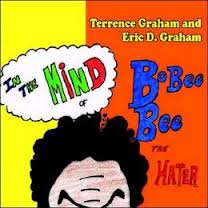
"BORN TO BE LOVED; LOVE TO BE HATED!"
His Anger Teaches Everybody Reality!!
It's your boy BOBBEE BEE "THE HATER" aka the trouble maker from the "city of brotherly love" I am an obnoxious, opinionated, third grader whose ego is bigger than T.O.! I am an "odd"combination of Terrell Owens, KOBE Bryant, Rasheed Wallace, and Allen Iverson!
by Eric D. Graham #TheRapProfessor. If you like what you are learning ($JeffreyBarnes)
Perhaps Mark Twain said it best: Twenty years from now you will be more disappointed by the things that you didn't do than by the ones you did." It isn't the things we did that we most regret; it's the things we didn't do.
To succeed at a high level, you must start expecting more.
Even when you don't get everything you expect, you'll get a whole lot more than if you were expecting nothing at all.
The moment you choose to settle, you guarantee you'll never achieve your real dream. Choose faith over fear.
Decision 2: I focus on solutions, not problem.
The bigger you dream, the more opportunity for obstacles, challenges and problems. Choose a mindset that sees these problems as opportunities for growth, and you will eventually walk into your vision.
Decision 3: I choose to be authentic.
Be yourself. Who else can you be? It takes less effort and energy to be yourself, but it also takes courage. Fear that you will not be accepted or approved just as you are can lead you to send your "representative" out into the world. She looks like the real you, but she's not. She's a counterfeit, and whatever success she has built on false pretenses that you must keep up to maintain success.
Decision 4: I choose courage over fear.
Like problems, fear is evitable. But it's not a stop sign. Fear is the most common obstacle to achieving true success and happiness. Fear tempts you to shrink from your authentic desires. It causes you to rationalize yourself out of a great idea. It leads you to pretend you don't really want what you really do want. Refuse to succumb to it. Make a decision that fear won't keep you stuck. Expect to feel fear. And when you feel it, keep moving forward.
Decision 5: I choose relationships wisely and nurture them intentionally.
Success doesn't occur in a vacuum. You need people, and they need you. Those with a strong support system have the resources that open doors of opportunity and empower them to manage any challenge. Don't go it alone.
Decision 6: I actively seed feedback and use it to grow. You need people around you who tell you the truth. Resilient people know this. And even when they don't like what they hear, they listen, process it and ask themselves, 'Is there a grain of truth to this feedback, even if it's negative? Be humble, and use failures and mistakes as learning tools. Put yourself around people who know more than you, and learn all you can from them.
Decision 7: I know my purpose and take daily action in the direction of my vision.
Consistency is key. If you continually take steps in the right direction, you will eventually arrive at your destination.
by Valorie Burton, who is a best-selling author and founder of the Coaching and Positive Psychology Institute.
1. to be 100% perfect
2. to follow the crowd
3. to love destructive people
4. to please unpleasant people
5.to apologize for being yourself
6. to drain your strength for others
7.. to feel guilty about what you desire
8.to put up with unpleasant situations
9.. to sacrifice your integrity for anyone
10. to remain in an abusive relationship
11. to do more than you have time
12.to do something you really cannot do
13. to conform to unreasonable demands
14. to give what you really don't want to give to bear the burden of another's misbehavior
15. to give up who you are for anybody or anything
BOBBEE BEE says that he has learned 12 things you need to know in 2012. 1. I've learned that HATRED is like acid. It destroys the vessel that holds it. 2. I've learned that if love isn't taught in the home it's diffcult to learn it anywhere else. 3. I've learned that marriages are meant to last a lifetime. When they don't, all the world suffers.
4. I've learned that regrets over yesterday and the fear of tomorrow are twin thieves that rob us in the moment.
5. I've learned that fame is written in ice and eventually the sun comes out.
6. I've learned that to get the right answer; you have to ask the right question.
7. I've learned that about 90% of the things that happen to me are good and only 10% are bad. To be happy, I just have to focus on the 90%. 8. I've learned to keep looking ahead. There are still so many good books to read. Sunsets to see, friends to visit, and old dogs to take walks with.
9. I've learned that you shouldn't do anything that wouldn't make your mother proud.
10.I've learned that if love isn't taught in the home it's difficult to learn it anywhere else.11. I've learned that I still have a lot to learn. To learn more about Bobbee Bee and to in order a copy of the book e-mail lbiass34@yahoo.com
Robert Smalls was an African-American born into slavery in Beaufort, S.C., but during and after the American Civil War, he became a ship’s pilot, sea captain, and politician.
He freed himself, his crew and their families from slavery on May 13, 1862, when he led an uprising aboard a Confederate transport ship, the CSS Planter, in Charleston harbor, and sailed it north to freedom.
His feat successfully helped persuade President Abraham Lincoln to accept African-American soldiers into the Union Army.
As a politician, Smalls authored state legislation that gave South Carolina the first free and compulsory public school system in the United States.
Madam Efunroye Tinubu (c.1805-1887)
Madam Tinubu was born in Yorubaland, an area in what is now known as Nigeria. She was a major political and business player, who campaigned against the influence of the British Empire over her people and for the elimination of slavery.
She became the first Iyalode of the Egba clan and is considered an important figure in Nigerian history because of her political significance as a powerful female aristocrat in West Africa. Iyalode (queen of ladies) is a title commonly bestowed on the most prominent and distinguished woman in a town.
After Tinubu, a former slave trader herself, realized the treatment of Africans enslaved in Europe and the Americas was far more inhumane than the way slavery was practiced in Africa, she became a scathing opponent of all forms of slavery and used her influence to try to eliminate the practice in her region.
Noble Drew Ali (1886-1929)
Noble Drew Ali, who was born Timothy Drew of North Carolina, was the founder of the Moorish Science Temple of America in Newark, N.J., in 1923. Soon after there were branches in Pittsburgh, Detroit, and other major industrial cities of the Northeast.
Ali saw Black nationalist leader Marcus Garvey as the inspiration for his own efforts. He wanted to present to Black people a message of pride, self-determination, personal transformation and self-sufficiency. Ali also intended to provide African-Americans with a sense of identity in the West, and promote civic involvement.
His movement inspired other leaders such as Fard Muhammad and Elijah Muhammad, leading to the creation of the Nation of Islam.
Claudette Colvin (born Sept. 5, 1939)
On March 2, 1955, a full nine months before Rosa Parks’ famous arrest, Claudette Colvin was dragged from a Montgomery bus by two police officers, arrested and taken to an adult jail to be booked. She was only 15 years old and was the first person to be arrested for defying bus segregation in Montgomery.
Her arrest and her story has long since been forgotten, but it provided the spark for the Black community in Montgomery that ultimately led to Parks’ actions, the bus boycott, and the Supreme Court ruling to end segregation on buses.
Benjamin Singleton (1809–1900)
Benjamin “Pap” Singleton was an American activist and businessman best known for his role in establishing African-American settlements in Kansas.
Held in slavery in Tennessee, Singleton escaped to freedom in 1846 and became a noted abolitionist, community leader and spokesman for African-American civil rights. He returned to Tennessee during the Union occupation in 1862, but soon concluded that Blacks would never achieve economic equality in the white-dominated South.
After the end of Reconstruction, Singleton organized the movement of thousands of Black colonists, known as Exodusters, to found settlements in Kansas. A prominent early voice for Black nationalism, he became involved in promoting and coordinating Black-owned businesses in Kansas, and developed an interest in the Back-to-Africa movement.
Matthew Henson (Aug. 8, 1866 – March 9, 1955)
Born to sharecroppers on a farm in Nanjemoy, Md., Matthew Alexander Henson became the first African-American Arctic explorer, and is credited by many as the first man to reach the North Pole, in 1909.
Henson was an associate of the American explorer Robert Peary on seven voyages over a period of nearly 23 years. Henson served as a navigator and craftsman, traded with Inuit and learned their language. He was known as Peary’s “first man” when it came to tackling the arduous expeditions.
Miriam Makeba (March 4, 1932 – Nov. 9, 2008)
Miriam Makeba or “Mama Africa,” was a South African singer and civil rights activist, known for denouncing apartheid on the world stage and campaigning abroad for the end of the oppressive policy.
As a result of her activism, her South African passport was revoked in 1960 by the apartheid regime, and they banned her from returning to her country in 1963. However, the world came to Makeba’s aid and Guinea, Belgium and Ghana issued her international passports. She received passports from six other countries in her lifetime, and was granted honorary citizenship in 10 countries.
Despite the success that made her a star, she refused to wear makeup or curl her hair for performances, proudly wearing what came to be known internationally as the “Afro-look.”
Her fourth marriage to civil rights activist, Black Panther, and Student Non-violent Coordinating Committee leader Stokely Carmichael in 1968 caused controversy in the United States, and her record deals and tours were canceled. The couple then moved to Guinea, and as the apartheid system crumbled, she returned to South Africa for the first time in 1990.
Martin Delany (May 6, 1812 – Jan. 24, 1885)
Martin Robison Delany was an African-American abolitionist, journalist, physician and writer. He was born free in Charles Town, W.Va. (then part of Virginia, a slave state). Delany was an outspoken Black nationalist, arguably the first; and is considered by some to be the grandfather of Black nationalism.
He was also one of the first three Blacks admitted to Harvard Medical School. Trained as an assistant and a physician, he treated patients during the cholera epidemics of 1833 and 1854 in Pittsburgh, when many doctors and residents fled the city.
Active in recruiting Blacks for the United States Colored Troops, he was commissioned as a major, the first African-American field officer in the United States Army during the American Civil War.
Henry McNeal Turner(Feb. 1, 1834 – May 8, 1915) Henry McNeal Turner was a minister, politician, and the first Southern bishop of the African Methodist Episcopal Church.
Born free in South Carolina, he moved to Georgia after the American Civil War, where he pioneered in organizing new congregations for the independent Black denomination.
Angered by the Democrats’ regaining power and instituting Jim Crow laws in the late 19th-century South, Turner began to support Black nationalism and the emigration of Blacks to Africa.
He was the chief figure in the late 19th century to promote the movement, which expanded after World War I.
Soledad Brothers
The Soledad Brothers were three African-American prison inmates: George Jackson, co-founder of the Black Guerilla Family, and Fleeta Drumgo and John Clutchette. The three were falsely accused of beating a white prison guard and throwing him from a third-floor tier to his death at California’s Soledad Prison on Jan. 16, 1970. The murder occurred just a few days after another white guard shot and killed three Black inmates by firing from a tower into the courtyard during a racial fist fight.
The Soledad brothers had recently led a hunger strike to combat the abusive, inhumane practices that led to the death of several Black inmates, when they were indicted for the murder.
Opie G. Miller, the guard who shot the three Black inmates, was exonerated in a secret trial where none of the Black inmates who witnessed the shootings were permitted to testify.
Less than a year later and just three days before the opening of his trial, George Jackson was shot to death by a tower guard inside San Quentin Prison in an alleged escape attempt. Some people called it an assassination and “No Black person,” wrote James Baldwin, “will ever believe that George Jackson died the way they tell us he did.”
The two surviving Soledad Brothers, Clutchette and Drumgoole, were acquitted by a San Francisco jury.
In recent years, the Hollywood movie industry has
come flocking to eastern North Carolina, thanks to the state's generous tax
breaks and the region's picturesque geography and historical landmarks.
In the wake of locally filmed blockbusters such
as "Iron-Man 3" and "The Hunger Games" a small independently produced movies have also begun cropping up from the state's fertile soil,
movies that focus on the day to day struggles of North Carolina's citizens to
tell smaller, but perhaps even more important stories.
Brothers Terrence and Eric Graham are two members
of a generation of artists attempting to tell those stories. Over the course of
three years, the Magnolia natives wrote, directed and produced the feature film
"Bobbee Bee the Hater," which chronicles the life a young man
struggling with self-confidence. The brothers describe the movie, which they
premiered at James Sprunt Community College on September 21, as a
"psychological comedy that takes a journey into the mind of a teenager
trying to cope with his anger."
The movie themes are rooted in the life
experiences of both Terrence and Eric, who have witnessed first hand the issues
that plague many young adults and have developed creative learning tools to
help those in need address their problems more effectively.
Older brother Terrance, 43, is a graduate of
North Carolina A&T State University who received a bachelor's degree in
psychology and a master's degree in psychology and a master's degree in agency
counseling.An Army Reserve veteran who
did a tour of duty during the Gulf War, Terrence has worked as a child
therapist since 1998 and currently runs his own practice, Graham Moore and
Clark, in Raleigh.
According to Terrence, his career path was set at
an early age.
"As a child I always wanted to be an
entertainer or a psychologist, he remembered. "I knew I always wanted to
work with children. I used to love reading comic books; I loved to draw. I used
to sell my comics at Rose Hill-Magnolia Elementary."
As a professional psychologist, Terrence said he
now incorporates that love of art in his children's therapy sessions, using his
books and drawing to help those he works with create their own superhero or
super villain characters.
Several year's younger than his brother, Eric
formerly worked as a sports reporter for the Wallace Enterprise and
Warsaw-Faison News and is a graduate of Winston-Salem State University, where
he received a bachelor's degree in Mass Communication in Radio & Television.
Currently, he is the editor and chiefof
Black Athlete Sports Network in Harlem, N.Y., where his articles appear daily
along with his cartoon "Here Comes The Hater," which features Bobbee
Bee, the inspiration for the movie character.
Like his brother, Eric is also a familiar face to
schoolchildren, having worked in Duplin County classrooms using the characters
he's created to educate and entertain students.
Bobbee Bee made his initial appearance in 2004 in
the first of a series of children's books, "In the Mind of Bobbee
Bee," which were co-authored by the Graham brothers. The books follow the
misadventures of the title character, who describes himself as "an
obnoxious, opinionated, third grader who ego is bigger than T.O.! I am an odd
combination of Terrell Owens, Kobe Bryant, Rasheed Wallace, and Allen
Iverson!"
Eric said the concept of the book series came
from watching his brother's son, William Shakur, and the influences he drew
from sports and Hip-Hop culture.
"Most child psychologists say at the age of
10 many African-American males begin to have behavioral problems in the school
system, so we tried to find a way to counter that," he explained. "We
developedcharacters that mimic real
life situations. We have books that deal with divorce and another where a child
loses a father in war-all things may cause a child to act out in school."
Eric said the stories also touch on some of the
grim realities faced by children, such as gangs and drugs.
"We wanted to make it educational but
entertaining," said Eric, "which was difficult thing to pull
off."
The film is rated PG-13 for mild language and
"a hint of violence."
"It's a clean film but you have to make the
characters believable," said Eric.
To play Bobbee Bee, the brothers turned to the
young man who the character sprang from, William Shakur. " It's a film
about his life and upbringing and our relationship," and Terrence.
"It's about his struggle."
Terrence said one of the biggest challenges of
"Bobbee Bee The Hater" was convincing his son of the film's importance.
"He was very resistant and reluctant at
first.
"It took a lot of sitting down and talking
to get him to be into it. At first he thought it was silly, but once he started
believing in what the script was saying and the script was saying and the
impact he'd after the movie came out, he was fine."
To represent the issues that Bobbee Bee faces in
the film, the Graham's used the unique device of personifying his conflicts in
the form of "THE HATER," anthropomorphic basketball who grimaces like
an angry pit-bull.
"It represents him getting cut from the
basketball team; it also represents his self hatred and insecurities,"
explained Terrence.
The Grahams said they began planning the movie in
2010.
"We had the idea to make a bigger impact
using visuals of the book. We sat down and made a plan and developed a company
5 Foot Productions, to do the film.
With the script written by Eric, the brothers set
out with one movie camera and 65 eager but inexperienced actors, including
approximately 40 Duplin County Natives.
"We're not actors, directors or script
writers -we're first time everything," said Terrence. "We're all
learning on the job."
With a shoot that encompassed location in
Virginia, Washington, D.C. , Winston-Salem, Raleigh, Magnolia, and Kenansville,
the Grahams said that traveling and pressures of filming formed the cast into a
tight, family.
"We didn't rely on professional
actors," added ERIC. "It's people in the community who I thought had
characterthat could be reflected in the
film, I just think there's a whole lot of untapped talent in Duplin
County."
Terrence said filming for "BOBBEE BEE THE
HATER" wrapped in March 2013. Having shot eight hours of film, theGrahams then faced the daunting task of
putting together a coherent, 92-minute movie.
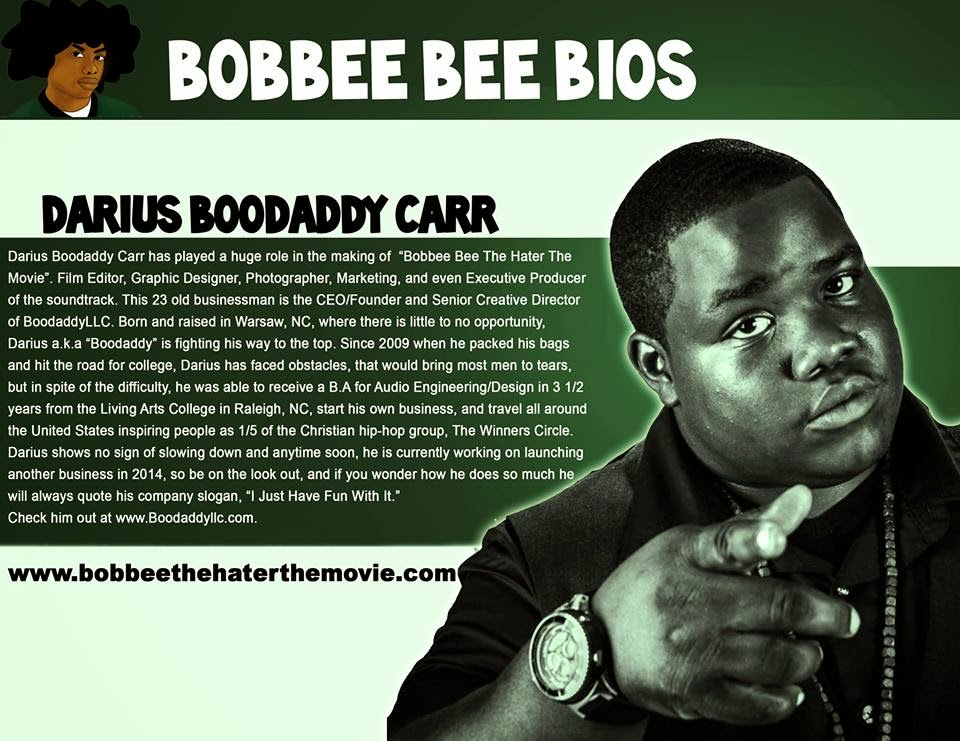
To help with the editing,the brothers turned to DARIUS
"Boodaddy" CARR, a JAMES KENAN High school graduate who attended
Living Arts College in Raleigh. Carr also helped put together the film's
soundtrack.
"I think he did an excellent job under a lot
of pressure. This was his first film as well," commented Terrence.
"It took a lot of hard work."
While he admits to few technical issues he'd like
to see corrected with the film, Eric said, overall, he's more than pleased with
the final results..
"I really do think it's an award-winning
film. It's original and we cover a whole lot of issues.
We commemorate the legacy of El Hajj Malik El Shabazz, also known as Malcolm X, on the day he was assassinated, February 21st, 1965.
Words cannot describe his revolutionary contributions to the struggle for liberation and self-determination.
We can only witness the products of his words and actions in the work that goes on to this day by warriors who he inspired to fight and free us all from what Malcolm called, “this miserable condition that exists on this earth.” We must see in our organizing work that there are thousands upon thousands of potential Malcolm X’s, from the rotten schools to the prisons.
There is hope.
He famously said, “If you don’t stand for something, you will fall for anything.”
So we ask you, where do you stand in the face of injustice?
Rest in Power Malcolm. You will never die as long as we fight for the change you hoped to see.
To understand the development of what we call salsa today, we need to examine its historical and cultural development from the time when en-slaved African people were shipped to the Americas, including the Caribbean.
From its African roots, salsa first developed in Cuba. As Thomas Guerrero, the Director of Santo Rico Dance Company has said, the origins of salsa lie in Africa and the Cuba.
It became popular throughout the Caribbean and Latin America, and finally made its way to mainland America and even the U.K. It is now truly global.
Salsa music is sometimes described as the African drum and the Spanish guitar which is African in origin. The guitar was brought into Spain by the Moors of North Africa who conquered Spain in AD 711. In 1492 they were overrun by the house of Castile and Oregon and ousted out of Spain.
The Catholic Church banned Moorish stringed instruments from being played in the streets.
Interestingly enough 1492 also saw the arrival of Christobel Colon in the Americas and the beginning of the removal and destruction of native people and cultures.
In the Age of Spanish Colonisation of South and Central America approximately 700,000 Africans were taken to Cuba.
Spanish political and ecclesiastical authorities put great pressure upon them to accept Catholicism; but a number of them, who came to reside in the remotest parts of eastern Cuba, enjoyed more freedom to practice their own African traditions and ways of perceiving God (the ALL).
With the Richie Incignito’s bullying case back in the news, we, at Blackathlete.net, felt that this article was worth re-publishing. Enjoy.
NORTH CAROLINA-(BASN)-Miami Dolphins’ Richie Incignito’s locker boasted: “There are two things I don’t like taxes and rookies.”
Case closed.
There is no other evidence needed in this court case.
Because, I am pretty sure Incignito is a man of his word.
For, Icignito’s hatred for “rookies” has gotten him in a lot of trouble throughout his turbulent nine-year NFL career, which in 2009 earned him to be named the dirtiest player in a poll conducted by Sporting News.
And, even though, hate is a word we “HATE” to use, it is a word which former NFL defensive player Lawrence Jackson used to describe Incignito on Twitter on Monday. “Hate is a strong word but I’ve always hated Incignito. Just for perspective, he’s the guy that makes you want to spit in his face……”
Unfortunately, for Incognito, who has admitted battling anger issues and bouts with depression, is currently the new face of bullying and hazing in the NFL after a voicemail left for his team mate Jonathan Martin was released to the media.
But, oddly, I feel that he probably will wear this label with a badge of honor like the tattoo that covers his huge arms.
Therefore, in this discussion involving Incognito’s behavior in locker room, I turn to the wisdom of Oprah Winfrey, who once stated, “Hurt people; hurt people.”
While this Aha-moment tries to simplify a complicated issue of hazing in the locker room, the bully in the locker room, is like the 800-pound Gorilla in the room, which nobody wants to recognize.
All of this pure speculation, however, only my bias opinion, which can’t be backed-up by any evidence whatsoever in this case involving Incognito-and-Martin, it simply provides sports fans a peak into the mindset of a football player in the NFL.
For this reason, I feel Incognito is the classic example of a bully, who wrecks havoc everywhere he goes.
Matter of fact, his inflated self-esteem, emotional flatness, and lack of conscience, which is probably driven by his quest for power, dominance and uncontrollable rush to create senseless “chaos,” is simply a facade to hide his insecurity in a league, where he, literally, was a nobody.
Why? Do I say this? Because, I have had first-hand experience of witnessing a white player similar to Incognito in my time as a football player at a HBCU, who was embraced, accepted and protected by other Black players, who in their own ignorance, gave him a “ghetto-pass” to tell “Black Mama jokes, sleep with Black girls, and fight other Black players on the team even while attending a Black college.
As a result, with the bloody rampage of a white kid in a league dominated by African-Americans, Incognito probably fully emerged himself into the locker room’s sub-culture, where the N-word was spit out of player’s mouth frequently, as a term of endearment.
Therefore, after developing a “streetwise” attitude, which probably involved “mastering” a few “black handshakes,” wearing his football starter cap backwards and listening to a “little” Hip-Hop in between, Incognito was eventually considered “cool” by a couple of Black players due to way he handled his “business” on and off the field.
And, gradually, overtime, a player, who probably was still searching to find his own identity and a permanent home in a league, where careers are short and friendships fleeting, started to believe he was “one of the homeboys” after being called “cool” and referred to as begin “down” shamefully was allowed to comfortably without repercussion to use the “N-word” in the presence of other Black players, while bullying another African-American player without protest.
For this reason, Incognito is a conformist and a coward, who in his attempt to bully another Black player, was only seeking shelter or group protection in fear of losing his own position and social status in a hierarchy of bullies, who roam the locker room.
In effect, he always found himself threatened by in-coming rookies, who probably were more talented than him and terrorized them in order from being terrorized himself or exposed.
Why? Because, deep down, he was probably lonely himself in the locker room full of African-Americans.
So, in his feeling invisible, he became more visible by stereotypically walking around in “blackface” in the locker room while hiding behind his whiteness when it is beneficial in the real world.
Ironically, this has become a reoccurring theme, usually amongst white entertainers like Eminem, Justin Timberlake, Justin Bieber, and recently Miley Cyrus, who seemingly surround themselves around Black bodyguards, who often offer them protection from other black people, while they pretend to be “bad-asses” and “tough” on stage.
Plus, if it is true that the “abused becomes the abuser”, Richie, who like most NFL players, love the structure and the gang camaraderie that the NFL provides.
In effect, they utilize a mob-like mentality while in the lock room in order to bully other players, whom they feel aren’t “tough enough” to be a part of their clan.
Because, surprisingly, NFL teams are actually a type of surrogate family for many players, who often find more comfort in them than their own dysfunctional families at home.
And, sadly, if most players like members of the military, are not submerged in this control-environment, where their lives are structured by schedules, team meetings, practice, and Sunday games, most would spin-out of control.
Therefore, if they are released or cut from their team, their coaches and their extended family with an honorable discharge or dishonorable discharge due to poor performance or bad attitudes, some players feel neglected and rejected, which leads many of them to engage in self-destructive behavior in order to be noticed by taking performance enhanced drugs, fighting in practices, throwing temper tantrums in the locker room, drinking alcohol, or snorting cocaine to cope with their depression.
And, unfortunately, like the military servicemen they emulate on the football field, some of these former fraternity members become homeless and hopeless after years of engaging in combat.
So, in the fear of losing their football livelihood and friends in the locker room, players like Incognito formulate harsh hazing techniques, pranks, scams, con games, death threats, protection rackets and cheap shots in order to preserve their place on a roster of 53 by running away unproven rookies.
It is quite juvenile in nature.
But, extremely effective.
A simple form of Darwin’s “survival of the fittest.”
In effect, the process of manipulation and victimization starts early in training camp.
So, players like Incognito, who have been labeled bullies, become members of hazing committees, where they sniff out the vulnerability and weakness in other young naive players like bloodhounds in order to inflict “a little” pain and misery in their lives, while “guarding” their positions on the team and hiding their insecurities.
Eric D.Graham, a graduate of Winston-Salem State University, where he received a B.A. in Mass Communication with a concentration in Radio and Television, with a minor in History, with an emphasis in African-American Studies, is currently the Editor and Chief of Black Athlete Sports Network, where his articles appear daily along with his controversial cartoon character Bobbee Bee “The Hater.” Graham can be reached at lbiass34@yahoo.com