"BORN TO BE LOVED; LOVE TO BE HATED!"
His Anger Teaches Everybody Reality!!
It's your boy BOBBEE BEE "THE HATER" aka the trouble maker from the "city of brotherly love" I am an obnoxious, opinionated, third grader whose ego is bigger than T.O.! I am an "odd"combination of Terrell Owens, KOBE Bryant, Rasheed Wallace, and Allen Iverson!
by Eric D. Graham #TheRapProfessor. If you like what you are learning ($JeffreyBarnes)
"Evil eyes envy guys in dope rides. Don't be surprised"-by Eric Graham from the song Wanted Men, which appears on the Soundtrack of the up-coming movie BOBBEE BEE THE HATER THE MOVIE.
One is a lonely road. But, the question remains? Are you one of them? Lurking in the dark.... With hatred in your heart... Plus, a mischievous spirit Who's plotting and planning..... Trapped in a web full of deceit.... If you are..... Remember, dirty secrets; tell no lies... So, get ready for the movie of the year. Why? Because, it's going to be a long hot summer. I promise.
With the current controversy involving former Food Network's star chef, Paula Deen, we, at Blackathlete.com, felt it was important for us to re-publish this outstanding educational list. (Enjoy and be enlighten)
By Debra Leigh, Organizer, Community Anti-Racism Education Initiative
Below is a list of 14 common racist attitudes and behaviors that indicate a detour or wrong turn into white guilt, denial or defensiveness. Each is followed by a statement that is a reality check and consequence for harboring such attitudes.
1. I’m Colorblind.
“People are just people; I don’t see color; we’re all just human.” Or “I don’t think of you as Chinese.” Or “We all bleed red when we’re cut.” Or “Character, not color, is what counts with me.” REALITY CHECK + CONSEQUENCE:
Statements like these assume that people of color are just like you, white; that they have the same dreams, standards, problems, and peeves that you do. “Colorblindness” negates the cultural values, norms, expectations and life experiences of people of color. Even if an individual white person could ignore a person’s color, society does not. By saying we are not different, that you don’t see the color, you are also saying you don’t see your whiteness. This denies the people of colors’ experience of racism and your experience of privilege.
“I’m colorblind” can also be a defense when afraid to discuss racism, especially if one assumes all conversation about race or color is racist. Speaking of another person’s color or culture is not necessarily racist or offensive. As my friend Rudy says, I don’t mind that you notice that I’m black.” Color consciousness does not equal racism.
2. The Rugged Individual, the Level Playing Field and the Bootstrap Theory.
“America is the land of opportunity, built by rugged individuals, where anyone with grit can succeed if they just pull up hard enough on their bootstraps.”
REALITY CHECK + CONSEQUENCE:
These are three of the crown jewels of U.S. social propaganda. They have allowed generation after generation to say, “If you succeed, you did it, but if you fail, or if you’re poor, that’s your fault.” Belief in this propaganda is founded on a total denial of the impact of either oppression or privilege on any person’s chance for success.
Attacks on programs like affirmative action find rationalization in the belief that the playing field is now level, i.e., that every individual, regardless of color or gender, or disability,
etc., has the same access to the rights, benefits and responsibilities of the society. The rationalization continues: since slavery is ended and people of color have civil rights, the playing field has now been leveled.
It follows, then, that there is no reason for a person of color to “fail” (whether manifested in low SAT scores or small numbers in management positions) EXCEPT individual character flaws or cultural inadequacies. These “failures” could have no roots in racism and internalized racism.
3. Reverse Racism.
A. “People of color are just as racist as white people.”
B. “Affirmative action had a role years ago, but today it’s just reverse racism; now it’s discriminating against white men.”
C. “The civil rights movement, when it began, was appropriate, valuable, needed. But it’s gone to the extreme. The playing field is now level. Now the civil rights movement is no longer working for equality but for revenge.” Or
D. “Black pride, black power is dangerous. They just want power over white people.” (Include here any reference to pride and empowerment of any people of color.) REALITY CHECK + CONSEQUENCE:
A. Let’s first define racism with this formula: Racism =racial prejudice + systemic, institutional power. To say people of color can be racist, denies the power imbalance inherent in racism.
Certainly, people of color can be and are prejudiced against white people. That was a part of their societal conditioning. A person of color can act on prejudices to insult or hurt a white person. But there is a difference between being hurt and being oppressed. People of color, as a social group, do not have the societal, institutional power to oppress white people as a group. An individual person of color abusing a white person – while clearly wrong, (no person should be insulted, hurt, etc.) is acting out a personal racial prejudice, not racism.
B. This form of denial is based on the false notion that the playing field is now level. When the people with privilege, historical access and advantage are expected to suddenly (in societal evolution time) share some of that power, it is often perceived as discrimination.
C+D. C is a statement by Rush Limbaugh. Though, clearly he is no anti-racist, both c+d follow closely on the heels of “reverse racism” and are loaded with white people’s fear of people of color and what would happen if they gained “control.”
Embedded here is also the assumption that to be “pro-black” (or any other color) is to be anti- white. (A similar illogical accusation is directed at women who work for an end to violence against women and girls. Women who work to better the lives of women are regularly accused of being “anti-male.”)
4. Blame the Victim.
“It’s their fault they can’t get a job, or be manager.”
Or “We have advertised everywhere, there just aren’t any qualified people of color for this job.”
Or “If he only worked harder, applied himself more, or had a stronger work ethic.”
Or “If she just felt better about herself – internalized racism is the real problem here.”
OR “She uses racism as an excuse, to divert us from her incompetence.” “If he didn’t go looking for racism everywhere…” (As if racism is so hidden or difficult to uncover that people of color would
have to search for it.)
REALITY CHECK + CONSEQUENCE:
All “blame the victim” behaviors have two things in common.
First, they avoid the real problem: racism.
Second, they take away from the picture the agents of racism, white people and institutions, who either intentionally perpetuate or unintentionally collude with racism.
This is similar to agent deletion in discussions of rape. Statements referring to a woman being raped, many by focusing on her clothing or behavior at the time of the rape and delete the male rapist from the picture.) As long as the focus remains on people of color, white people can minimize or dismiss their reactions, and never have to look directly at racism and the whites’ own responsibility or collusion.
5.The White Knight or White Missionary.
“We (white people) know just where to build your new community center.”
Or “Your young people (read youth of color) would be better served by traveling to our suburban training center.”
Or “We (white people) organized a used clothing drive for you; where do you want us to put the clothes?”
REALITY CHECK + CONSEQUENCE:
It is a racist, paternalistic assumption that well meaning white people know what’s best for people of color.
Decision, by white people, are made on behalf of people of color, as though they were incapable of making their own.
This is another version of “blame the victim” and white is right. It places the problems at the feet of people of color and the only “appropriate” solutions with white people. Once more the power of self-determination is taken away from people of color. Regardless of motive, it is still about white control.
6. Lighten up. (Lighten? Whiten?)
“Black people are just too sensitive and thin-skinned.” Or Indians should get a sense of humor. We’re just kidding around.” Or “I didn’t mean anything racist; it’s just a joke.
People are overly sensitive these days…the Redskins should never change their name.
REALITY CHECK + CONSEQUENCE:
Here are racism and agent deletion in partnership again. The problem and perpetrators are exonerated, because the rationale declares that humor isn’t hurtful. This form of denial serves most to trivialize the pain and reality of daily racism. 7. Don’t Blame Me.
“I never owned slaves.” Or “I didn’t vote for David Duke.”
Or “None of my family joined the Klan.” Or “I taught my children that racism is wrong.”
REALITY CHECK + CONSEQUENCE:
Often white people hear blame whenever the issue of racism is brought up, whether or not blame has been placed on whites.
As beneficiaries of racism and white privilege, you sometimes take a defensive posture even when you are not being individually blamed.
You may personalize the remarks, not directed personally at you. It is the arrogance of your privilege that drags the focus back to whites.
When whites are being blamed or personally accused of racist behavior, this defensiveness and denial further alienate you and may preclude you from examining your possible racist behavior.
8.BWAME.
“But What About Me. Look how I’ve been hurt, oppressed, exploited…?
REALITY CHECK + CONSEQUENCE:
This diminishes the experience of people of color by telling our own story of hardship. We lose an opportunity to learn more about the experience of racism from a person of color, while we minimize their experience by trying to make it comparable or less painful than ours.
9. We Have Overcome.
“We dealt with racism in the 60s with all the marches, sit-ins and speeches by Dr. King. Laws have been changed. Segregation and lynching are ended. We have some details to work out but real racism is pretty much a thing of the past.”
REALITY CHECK + CONSEQUENCE:
The absence of legalized, enforced segregation does not equal the end of racism. This denial of contemporary racism, based on inaccurate assessment of both history and current society, romanticizes the past and diminishes today’s reality.
10. The End Run, Escapism.
“Of course, racism is terrible, but what about sexism? Or classism or heterosexism?” or “Racism is a result of classism (or any other oppression), so if we just work on that, racism will end, too.” REALITY CHECK + CONSEQUENCE:
I agree with Audre Lorde’s statement, “There is no hierarchy of oppression.” I would not establish a rank order for oppressions. At the same time, we cannot attempt to evade recognition and responsibility for any form of oppression.
Statements like the ones above divert attention from racial injustice to focus on some other form of oppression.
They are usually said by white people, (women, working class people, lesbians, gay men or others) who experience both white privilege and oppression in some form. Whites are more willing and more comfortable decrying our oppression than scrutinizing our privilege. Oppressions are so inextricably linked that if whites allow their fear, guilt and denial to constantly divert them from confronting racism, even while we work to dismantle other forms, no oppression will ever be dismantled.
11. Due Process.
“Lady Justice is color blind.” White parents who tell their children, “The police are here to protect you. If they ever stop you, just be polite and tell the truth.” Then when a black teen is beaten or killed by police, those same parents say, “He must have been doing something wrong, to provoke that kind of police response.”
REALITY CHECK + CONSEQUENCE:
White people’s belief that the police, courts, the legal system and social services work without bias; that due process, fair trials, juries, judges, police officers and case workers have everyone’s, including people of color, best interest at heart. Or at least, no less than they do for white people. This belief clouds reality. Whites tend to look at isolated incidents rather than the patterns of institutionalized oppression.
12. The Innocent by Association.
“I’m not racist, because… I have Vietnamese friends, or my lover is black or I marched with Dr. King.”
REALITY CHECK + CONSEQUENCE:
(Perhaps, if all white people who say they marched with Dr. King actually had, the current situation would look different!)
This detour into denial wrongly equates personal interactions with people of color, no matter how intimate they may be, with anti-racism. There is an assumption that our personal associations free us magically from our racist conditioning.
13.The Penitent.
“I am so sorry for the way whites have treated your people.” Or “I am sorry for the terrible things that white man just said to you.”
“REALITY CHECK + CONSEQUENCE:
While there is probably no harm in the “sorry,” if it is not attached to some action taken against racism, it is most often just another expression of white guilt. Being an ally to people of color is not limited to an apology for other white people’s behavior, it must include anti-racist action.
14.The Whitewash.
He’s really a very nice guy, he’s just had some bad experiences with Koreans.” Or “That’s just the way Uncle Adolf jokes. He’s very polite to the black janitor in his building.
'What I would really like is a bunch of little n******s to wear long-sleeve white shirts, black shorts and black bow ties. Now, that would be a true Southern wedding wouldn't it?'-
by Eric D.Graham
NORTH CAROLINA (BASN)-Paula Deen, the Food Network's cartoonish cook, with those bright blue, toilet water eyes, who used her southern slang and country cornbread to win the hearts and stomachs of America with her "deadly" soulful recipes, cooked up some more greasy, finger-licking racism with her admission that she used the "N-word" as she busted a "nut" with her sexual fantasy of having a plantation style wedding with Blacks posting as "slaves" wearing black and white tuxedos serving their white owners and masters.
But according to some Black intellectuals, Black people shouldn't be upset with Deen's Gone With The Wind wet-dream of Black butlers, Black maids, and white brides.
Why? Because, they feel that we have become too sensitive to a word most of us use or hear every day.
Besides, Paula Deen made those remarks years ago.
Unfortunately, however, if the tables were turned or turned over in this case, how would the "so-called Jews" react in the same type of situation if another celebrity chef confessed that he or she wanted to have a Holocaust themed-party, where the guests attending would be dressed as if they were Nazis.
What would be the backlash?
Let's not forget, all of this Paula Deen controversy in the kitchen occurred on the 4th anniversary of Michael Jackson's death, who, if we recall, was punished verbally and economically by singing, "Jew me, sue me..." in his hit song They don't care about us, which in effect he had to remove all of his Cd's containing those lyrics.
Yeah, this Paula Deen controversy, which has engulfed the country, is coming at a pivotal moment in American history, especially with a Black man in the Oval Office, as the country takes a step back in time, as the Supreme Court ponders eliminating affirmative action and the Voting Rights Act of 1965.
Seriously, if we are not careful they might start posting White Only signs in restaurant windows again and begin to implement a "back door policy" for Blacks and Mexicans.
But, unfortunately, some of us would picket them, boycott them, and stand in long lines to patronize them anyway, despite their refusal to let us in after being mistreated, instead of opening our own restaurants.
Some scholars, however, believe all of this attention given to this plantitum haired multi-millionaire, who has authored 14 cookbooks, which have amazingly sold more than 8 million copies, is simply a distraction from more important issues affecting America like the recent scandal involving the National Security Agency's illegal and unconstitutional surveillance program on all American citizens. (Read my article: Big Brother is Watching on BASN)
Freedom of Speech and the Thought Police
But, on a deeper note, Paula Deen and the scandal involving NSA and Eric Snowden are strangely connected. I have consistently been on the record every time some Caucasian has had a "brain fart" and used the "N-word" while on the air or in conversation, whether its been Dr. Laura , Don Imus, or Kramer, from Seinfeld, that they shouldn't be fired or denied the ability to make a living due to their stupidity.
And, I still hold on to that belief in the current public flogging of Paula Deen.
As I have previously stated in an article entitled Broken Pencils are Pointless published on BASN , I believe in freedom of speech, whether it's from former ESPN analyst Rob Parker, who felt Robert Griffin was a "cornball brother".
Or whether it comes from country singer Hank Williams Jr, who was fired from ESPN for comparing President Obama to Hitler .
Plus, I repeat, I would rather know what a person really thinks rather than blindly believe what they say in order to maintain their corporate sponsorships.
Matter of fact, Dr.Frances Cress Welsing , author of The Isis Papers; The Keys to the Colors says that is the only way one can truly understand White Supremacy and how it works, is if you hear it operating behind closed doors.
So, firing people for using what we deem inappropriate language in their past, creates sort of a thought police, whom we give permission to patrol the Internet for old e-mails, blog posts, face book messages, and spy on our closed conversations, looking to pass out tickets and handcuffs for someone who has used a certain word, or phrase.
Seriously, we must be careful how we judge one another, especially during this time in history.
Bigger catfish to fry
I mean, open your eyes and see the bigger picture, not just the food on the plate.
Or the cook in the kitchen, for that matter, whether they're Black or white.
Seriously, we all know that, we have bigger catfish to fry than to worry about whether Paula Deen said the "N-word" today, tomorrow or twenty years ago.
Honestly, this incident could simply be a shakedown for cash.
Because, being a celebrity can be very expensive and costly these days, as people try to use a person's celebrity status to gain some publicity and financial gain during these harsh economic times.
Case and point, consider the recent arrest of former NBA superstar Scottie Pippen, who was placed under arrest after assaulting a crazed fan, who while requesting his autograph outside a restaurant, spit on him and called him a "Nigger..."
Yeah, that infamous "N-word" keeps popping up all over the country, even though the NACCP buried it on July 9, 2007 in an elaborate funeral ceremony.
Whether in a funeral or wedding, or in, or outside a restaurant, Pippen decided to open up a can of "Whup ass" when it was spit at him.
RACE AND SPORTS
With that incident fresh in our minds, is it safe to say that the "fan" of Scottie Pippen was a racist, even though he wanted his autograph.
Here's were some white folks get confused and outraged at being called a racist, because they believe that they couldn't be racist, due to the fact that, they "love" or "cheer" for a particular Black athlete, who plays for their favorite team, who can dunk, run fast, or hit a home run.
For example, recently during an interview with CNN, Deen's two sons Jamie and Bobby, tried to convince the world that their mother wasn't a racist by referring to the time she purchased one of them a pair of Hank Aaron pajamas.
Yelp, I am convinced after hearing that moving testimony.
Hank Aaron, of course, played for the Atlanta Braves and broke Babe Ruth's home-run record on April 8, 1974, when he hit his 715 th career home-run.
Unfortunately, this theory of having a favorite Black athlete as your sports hero means you can't be racist- fails miserable. And even though, most Caucasians will claim they don't see their famous athletes or entertainers as being Black, especially if they are winning championships and making them money.
Sadly, when they mess up, start losing, become too political, join forces with someone they don't approve of, or get too smart, they quickly start to see their true colors. Ask Michael Vick, Tiger Woods, Mike Tyson, Lebron James or O.J.Simpson?
Therefore, I guess, Paula Deen was simply a product of her environment.
A child of the Old South, whose great Grandfather committed suicide after his 30 slaves were set free, whom I assume loved to fly the Confederate flag, and laughs when people call Blacks "monkeys." (Read my article King Kong Ain't Got Nuthin' On Me:More Monkey Business)
I didn't make that up.
According to the attorney of the ex- former employee suing the celebrity chef, Paula Deen allegedly allowed a relative to address a black staff member as 'my little monkey' .
Yeah, that calling Black people monkeys is a common practice amongst racist rednecks.
Just ask ESPN columnist Jemele Hill, who shared earlier this year an alarming letter with her Twitter followers, which she reportedly received after having made multiple appearances on sports radio show “The Herd” from a disgruntled viewer, who called her a "bitch jungle bunny," "spear-chucker," and re-enforced that he was "not interested in spending all day listening to some thick-lipped gorilla attempting to properly speak the King's English."
Yes, this was the main ingredients that made up Deen's thought process, formatted her words, shaped her tongue which she served with a tub of sweet-Tea, a diabetic smile, and a big ole Oprah hug with a "honey child greeting."
Therefore, it was silly for some to try the old "bait and switch" theory that suggest that Hip-Hop music was the blame for Deen's southern attitude and usage of the "N-word."
Believe me, she was using "Nigger" long before Jay-z and Kayne West's "Niggas in Paris" was released and hit the airwaves.
ART IMITATES LIFE: A DJANGO MOMENT
As a result, Pastor Gregory A. Tyson Sr., an African-American pastor at First Jerusalem Missionary Baptist Church in Savannah and TV-One's Roland Martin's "Uncle-Tom" like defense of Paula Deen's corporate brand is no different, in my opinion, than from Samuel L.Jackson's character Stephen, who excessively used the "N-word" throughout Quetin Tarantino's controversial movie Django , which mostly white moviegoers watched and laughed at hilariously for almost three hours.
But unfortunately, for all my Black folks, who have fallen in love with Miss Paula Deen, her fate in the end, will be no different than that of the always smiling Lara Lee Candie-Fitzwilly(played byLaura Cayouette)–who in the movie, represents a "good" white woman, that was blown away cartoonishly by Django, who was played by Jamie Foxx when she was shot.( Read my previous article on BASN entitled: Django Unchained: the clash of a spaghetti Western and a Black exploitation flick).
Sadly, Django had to tell the Candie's house servants to tell Miss Lara bye before killing her. Because, psychologically they were still attached to her or in love with her.
Well, art imitates life.
Now, before you start to misinterpret my words, I am not suggesting that someone's is going to kill
Paula Deen.
But, someone in corporate America, is slowly trying to "kill her career."
Because, this perfectly describes this current situation involving the southern-cooking star, who has been making millions of dollar playing a stereotypical country-caricature, who fries chicken on television.
Yeah, Deen, who allegedly uses at least eight sticks of butter in her Macaroni and cheese looked as if she was going to have a heart attack as she apologized over and over again, fighting back tears on the Today Show, while trying to convince the world that she is not a racist.
But, sadly, for Miss Paula Deen, America was built on racism.
RACIST AS APPLE PIE
And if you have forgotten...the school system teaches racism.
The church preaches racism.
The military defends racism.
The police protects racism.
And television promotes racism.
Let's not pretend you haven't seen that Old Spice commercial with the white guy cutting the basketball in half that "mysteriously" is a watermelon inside. (We will discuss that later in another article.)
So, it would be hard for her not to have "a little bit of racism in her heart."
Because, truthfully, in runs deep in her Southern blood.
It hangs from the trees, in which she swung from as a child.
It is part of her southern plantation tradition.
In other words, she can't help her self.
It comes naturally.
For instance, in a bizarre moment, when the former Food Network star was talking about a Black employee of hers named Hollis Johnson on television, without even thinking about it, Deen displaced some of her southern hospitality along with her racist sense of humor when she called Johnson on stage and said, " We can't see you in front of that dark board!"
And just like one of those horrible comedy skit from HA-HAW, the audience shamefully bursted out loud in laughter.
Maybe, it's just a case of her being an Accidental Racists like BradPaisley and L.L.Cool J suggested in their horrible song.
Here are a few lyrics from the song: And I just walked him right in the room Just a proud rebel son with an ‘ol can of worms Lookin’ like I got a lot to learn but from my point of view I’m just a white man comin’ to you from the southland Tryin’ to understand what it’s like not to be I’m proud of where I’m from but not everything we’ve done And it ain’t like you and me can re-write history Our generation didn’t start this nation We’re still pickin’ up the pieces, walkin’ on eggshells, fightin’ over yesterday And caught between southern pride and southern blame They called it Reconstruction, fixed the buildings, dried some tears We’re still siftin’ through the rubble after a hundred-fifty years I try to put myself in your shoes and that’s a good place to begin But it ain’t like I can walk a mile in someone else’s skin
But despite all the press given to Deen for using the N-word and Brad Paisley's song, the lawsuit against her is oddly filed by a former employee named Lisa Jackson, who worked at Uncle Bubba's Seafood and Oyster House, which is a Savannah restaurant owned by Deen and her brother, Bubba Hiers. Comedically yet stereotypically, you knew that this story was going to have a dude named Bubba involved in it, who of course, has an alleged drinking problem, a cocaine habit, watches porn, and tells racist jokes.
Shockingly, however, Jackson, a white female, and long term manager, who filed a discrimination lawsuit last year, claims she was sexually harassed for several years while working for Deen and her brother, who created a hostile working environment riffed with racial innuendos and racial slurs.
Jackson also claims Deen's brother referred to President Obama as a 'n*gger' and watched pornography on work computers.
With all of this brouhaha surrounding Deen, unfortunately, she continues to lose endorsements deals and sponsorships from corporations like Wal-mart, Home Depot Inc., Target Corp., Caesar Entertainment, pork producer Smithfield Foods and diabetes drug maker Novo Nordiskand. Now, one has to wonder whether Paula Deen will reunite with her former freed "slave," Beloved-Oprah Winfrey, in order to butter her up, cry some "crocodile tears" on her big black bosoms, while begging for forgiveness, as she offers her to stay in the big house and not the guest house for her next interview saying, "Oh, Mammy!! I is so sorry!!!" "You know, I love my nigras..."
Unfortunately, at this time, Paula Deen is eating a big ole shit pie like the one cooked by Viola Davis in the movie the Help, along with some of her famous monkey bread, she famously made for Whoopi Goldberg on the View, as her $17 million empire, crumbles like the crust off of one of her toxic antebellum southern apple pie.
GREENSBORO — Eighty-nine times. That's what he remembers.
Brandon Richardson-Evans had moved 89 times between the ages of 9 and 16. He counted. He bounced from foster homes to group homes to homeless shelters and two detention centers where he stayed after his anger went volcanic.
His life has been full of chaos.
At 4, he heard his dad stab his mom. Brandon saw the blood.
At 9, he watched his mom die in a hospital bed from breast cancer.
At 16, he left Maryland and came to live with his dad in Greensboro.
His dad asked him to come. He wanted to get Brandon out of trouble, and he told Brandon he had an apartment, a car. But his dad was living in the local shelter.
After that, his dad abandoned him.
Twice.
His dad says he left to find work.
Still, he left Brandon on his own.
And now, at 21, Brandon has a tattoo on his right arm.
It's an image of one of the last things he saw in his mom's hospital room — her pulse.
A few days ago, he had that stark, spiky outline of life and death shaved into the back of his head.
He had made a promise to her on her deathbed, and he aimed to keep it.
He was going to graduate. And with his tattoo and the spiky line above his neck, she was going with him.
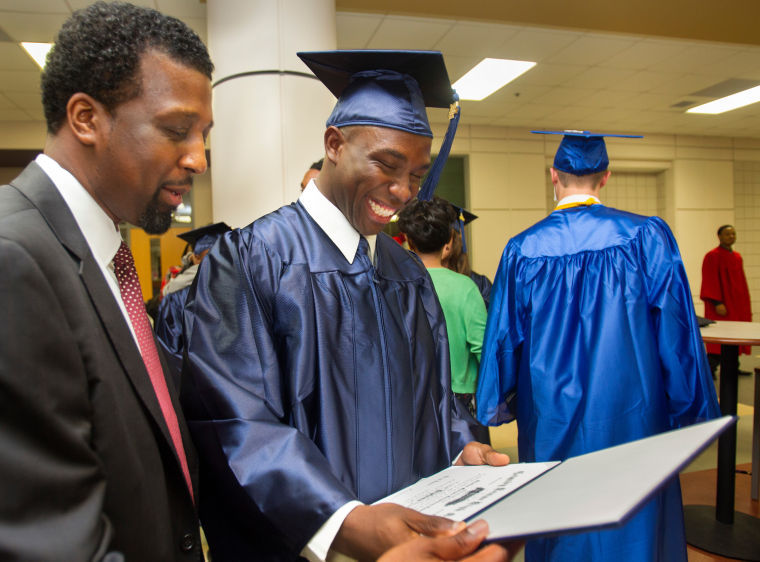
With his cap and gown under his arm, Brandon slips into Duane Lewis' Honda Accord. "My dad is coming," Brandon tells Lewis breathlessly.
"How do you feel?" Lewis asks.
"Good."
"Now, listen, you get up there and step to the mic and focus," Lewis tells him. "Read slowly. The words will come out. That feeling, it comes from the heart."
Lewis is 44, a school social worker from Goldsboro and educated at N.C. A&T.
He has worked in Guilford County Schools for 17 years. So, he has seen many kids like Brandon — broken, lost, angry and alone.
He is one of many who have helped Brandon. For the past year, he has guided Brandon through his days at Twilight School, a place of second chances for students wrestling with bad grades, poor attendance and the responsibilities of being a parent or being on their own.
Brandon lives at Joseph's House. It is a two-story home in east Greensboro that has become a faith-based nonprofit that helps homeless young men from age 18 to their early 20s.
In 2008, Brandon came to Greensboro to live with his dad. When his dad left, Brandon first stayed at the city's homeless shelter and later with a friend's family as he bounced from Dudley High to Grimsley High.
In November, he moved into Joseph's House. And there he has stayed — up 16 steps, in a small bedroom where he keeps his four pairs of shoes, his half-dozen shirts, his Old Spice and his stack of books a foot high.
He has spent many hours talking to Lenora Cooke, the nonprofit's program director. He tells her about his life — of his mom's stabbing, his mom’s death, his bouncing around 89 times before landing in Greensboro and finding himself alone.
Brandon has a name for it: "The Struggle."
"Miss Cooke," he tells her. "You don't know. When you're in The Struggle, it's hard to look up."
But the closer to graduation, the more excited Brandon gets.
"Miss Cooke, you know what I'm going to tell my family," he has told her. "I'm going to tell them, 'Look at me. I did it.' "
It is Thursday.
And it is time.
Brandon arrives at Northern High with Lewis and steps into Room 179, where Twilight graduates gather down the hall from the auditorium where they all will take the big walk.
Brandon will finally graduate. It took him seven years. And his father will see it. That's what makes Brandon nervous. His conversations with his father often turn into shouting matches.
Once again, Brandon will ask his dad about stabbing his mom, and he wonders if he'll get a different answer than, "I was mad."
He knows he won't forget that. It was his mom, and his dad went to prison for what he did.
But he has forgiven his dad.
Lewis has helped him with that as well as his anger. Brandon knows if he doesn't forgive, he won't be able to move on and start a new life.
He still remembers what his 45-year-old mother, Willie Mae Richardson, told him as she lay in her hospital bed during her final days.
"You know, I'm not going to be here," she said. "Promise me one thing. You're going to graduate."
"I promise," Brandon responded. "I don't care how long it takes or how hard it gets."
So, as he walks into Northern High's auditorium Thursday, he thinks about that, his speech and his dad. Mainly, though, he wishes his mom was in a seat. He sits up front, behind a row of school officials. His face is stoic.
For four days, Brandon has rehearsed his speech in his bedroom. He wants it to be right. He remembers what Lewis told him. Speak slowly. When it's time, he steps to the microphone and begins.
He talks about his dad leaving him twice, and he mentions the names of the many people who have helped them. He talks in a monotone, hardly looking up as he reads from his three-page script. But by the time he gets to the end, he looks out over the crowd and smiles.
Big.
"I told my mom the day that she passed away that I was going to get my high school diploma no matter how long it took and how hard it was," he says. "I would never give up."
After his speech, Brandon finds his dad.
George Evans is 60, slender with a bald head, sharp in a suit. He drove from Wilmington for the graduation, and Brandon finds him standing in a corner outside the auditorium. Brandon approaches. He smiles. They shake hands. They talk.
Brandon asks about the stabbing. His dad pretends he doesn't hear him and changes the subject. Brandon doesn't bother to follow up. But you see it in his face. His smile vanishes.
Brandon thanks him for coming. Lewis does, too. He called Evans to come.
"Thank you for what you did," Evans tells Lewis, shaking his hand. "I know."
Then, Evans is gone. He tells Brandon it could be years before he sees him again. No matter. Brandon knows he never could depend on him. He simply knows what his next steps will be.
Walk with Grimsley High, his home high school, Sunday night during its graduation. Start at GTCC this fall. Look to transfer to N.C. A&T and major in mechanical engineering. And try to play football.
At 6 feet, 189 pounds, built solid, strong and fast, he believes he can do it.
But right now, it's Thursday night, and it's back in Lewis' Honda Accord, back toward another night at Joseph's House.
But it's time to celebrate. He kept his promise — to his mom and to himself.
"I'm going to take a picture of this (diploma) before the light goes out," says Brandon, sitting in Lewis' car and speaking faster and louder with every word.
"I'm going to show everyone I got a diploma! I'm going to show the world! Facebook! Everyone is going to see it! And I'm going to say, 'Remember when you said I couldn't do it?! ' "
"You don't have to say, 'Remember when,' " Lewis responds. "You just send it out. They'll get it."
Contact Jeri Rowe at 373-7374 or jeri.rowe @news-record.com.
(Picture to the left Editor and Chief of Black Athlete Sports Network Eric D.Graham and school counselor Duane Lewis)


 Jordan Black